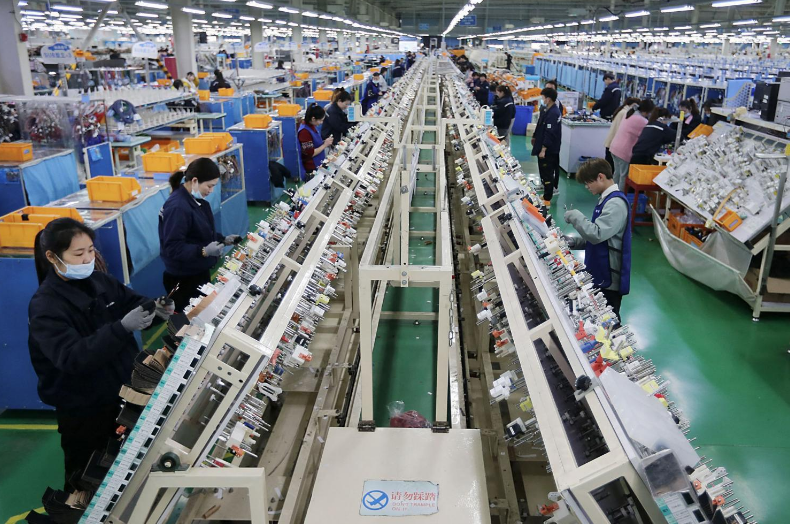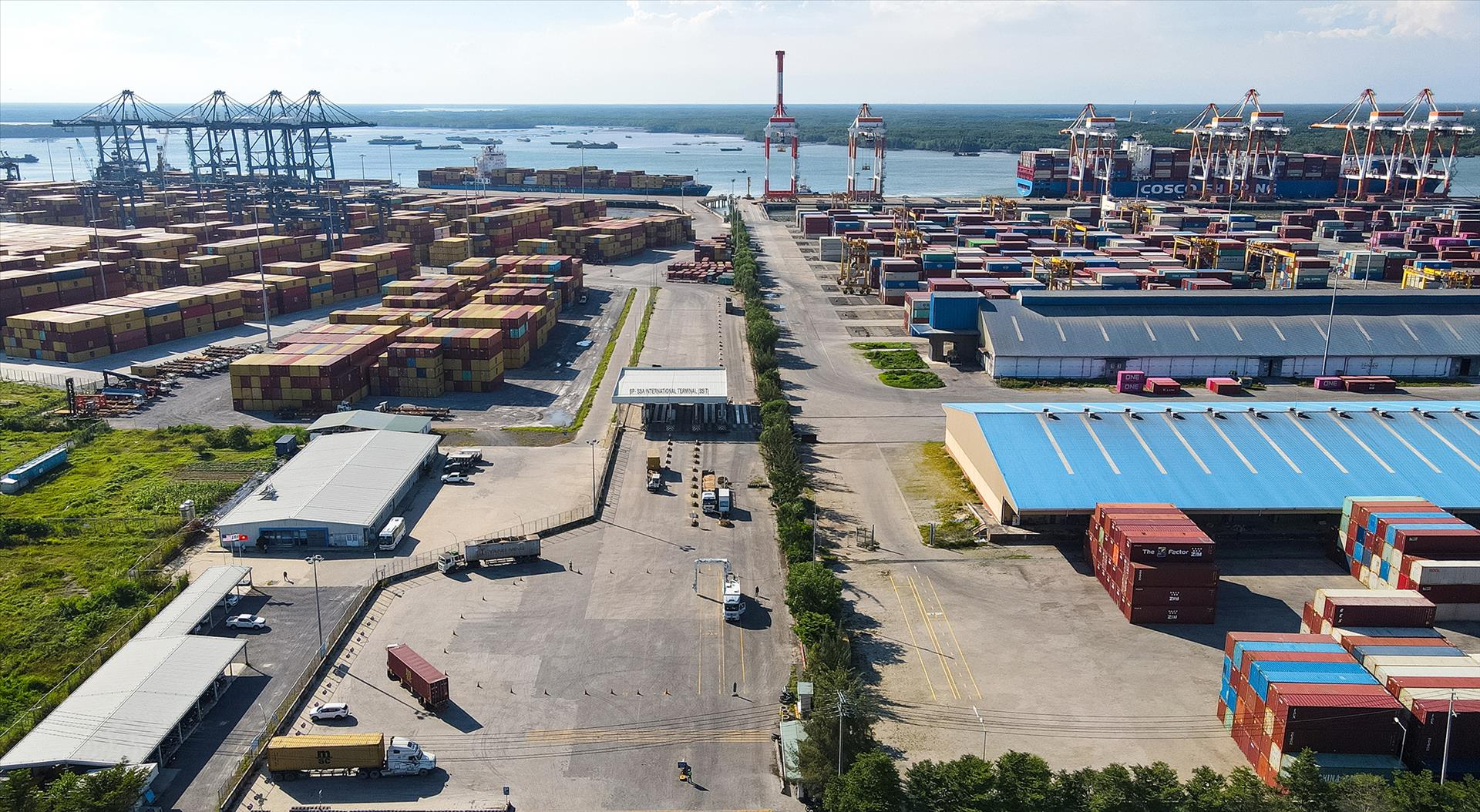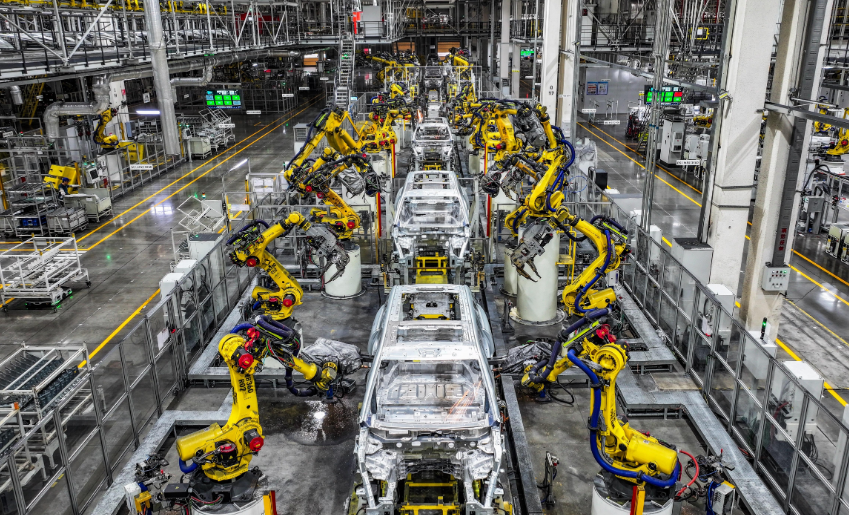
Robots assembling components, cameras detecting defects, warehouses where goods move automatically: in China, in 2026, these technologies are already a reality and play a growing role in industry.
In 2025, 354,000 industrial robots were installed in China, accounting for 59% of new global installations, according to the International Federation of Robotics (IFR). This compares with 4,500 robots installed in France the same year, down 8% compared with 2024.
This evolution illustrates the rise of smart factories, particularly in China.
But what does this concept really cover?
Which technologies are used?
And above all, what does it change for companies that want to manufacture their products in China?
What is a smart factory?
A smart factory is a factory that combines automation, connected equipment and data analysis to manage and optimise its production.
Unlike a factory based mainly on manual operations, a smart factory can connect its machines, track their performance in real time and automate various manufacturing stages.
This organisation is part of the principles of Industry 4.0, which combine robotics, artificial intelligence, industrial sensors and production management software.
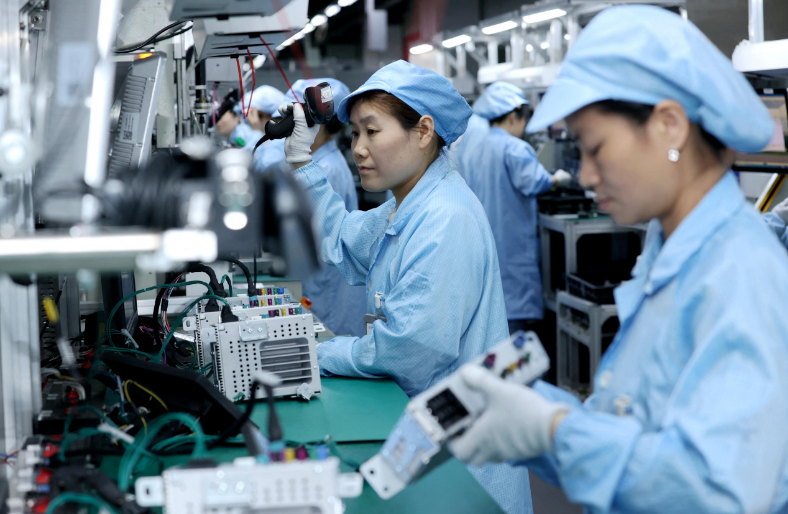
Take the example of a factory manufacturing electronic devices. Machines place components on printed circuit boards, cameras inspect assemblies and software tracks the progress of orders.
Operators remain essential for supervision, maintenance and technical interventions. The goal is therefore not necessarily to remove human presence, but to make production more consistent, more precise and more efficient.
The five technologies transforming Chinese factories
1. Industrial robots
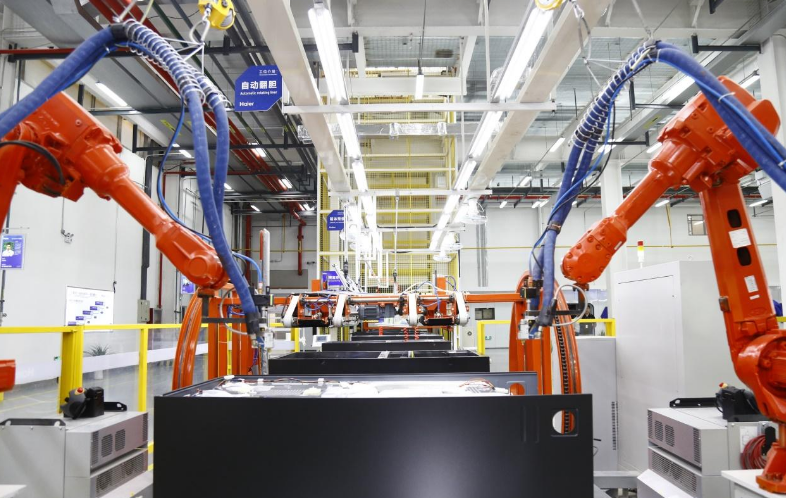
Industrial robots perform repetitive operations such as welding, assembly, painting, cutting or handling.
In the automotive industry, robotic arms weld body components. In electronics, automated equipment places components on circuit boards with great precision.
These installations improve the consistency of operations and reduce operators' exposure to certain strenuous or dangerous tasks.
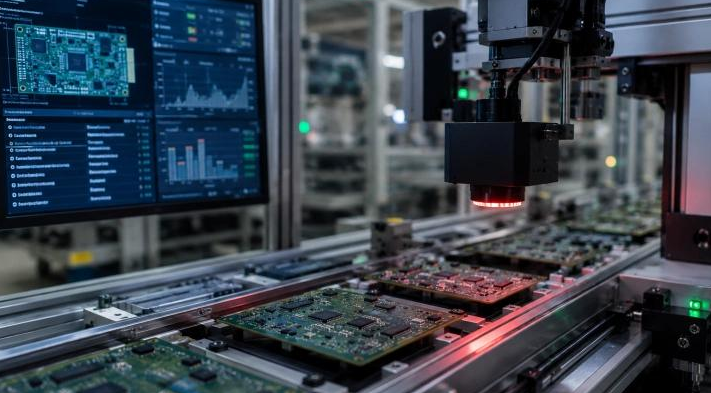
2. Camera-based quality control
Industrial vision systems make it possible to inspect products directly on production lines.
They can detect missing components, visible defects, positioning errors or certain dimensional anomalies, depending on the equipment used.
For example, a camera can check the presence and correct positioning of components on a circuit board before it moves to the next stage.
Artificial intelligence can also improve these systems by making it easier to recognise more complex defects.
Note: a camera is not always able to detect an electrical problem, a mechanical weakness or non-compliant material. Functional tests and quality controls adapted to the different production stages remain essential.
3. Digital production tracking
Smart factories use in particular MES (Manufacturing Execution System) software to track and manage industrial operations.
These systems centralise information such as quantities produced, incidents, downtime and quality control results.
For an order of 20,000 electrical devices, for example, the manufacturer can track the progress of the different batches and quickly identify a slowdown or a production problem.
This visibility facilitates planning and makes it possible to communicate more precise information to buyers, when the factory gives them access to this data.
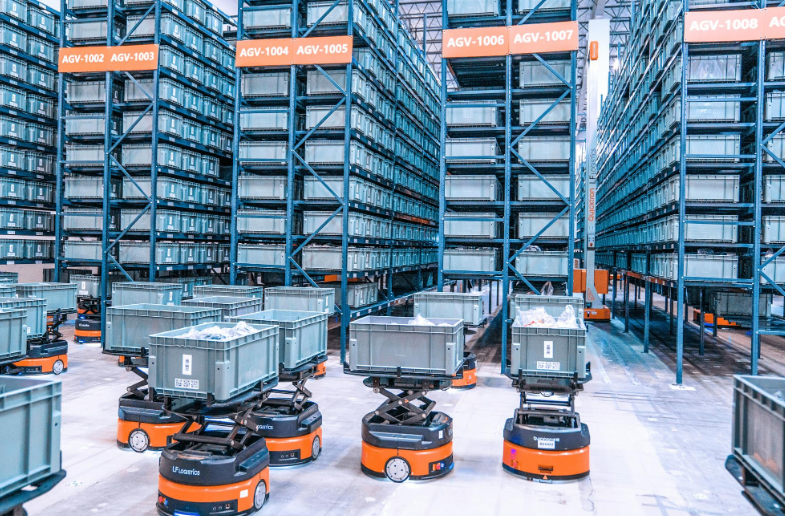
4. Automated warehouses
In the most advanced industrial sites, conveyors, automated storage systems and mobile robots handle part of the movement of goods.
Components can be routed to production lines as needed, while finished products are automatically directed to storage areas.
The goal is to reduce manual movements, better organise internal flows and limit handling errors.
5. Dark factories: producing in the dark
Dark factories, or lights-out factories, represent an advanced form of automation. In these facilities, certain production areas operate without permanent human presence. Lighting can be reduced or even eliminated, since machines do not need it to operate.
This does not mean, however, that the entire factory operates without staff. Maintenance, programming, supervision and interventions in the event of an incident remain necessary.
These facilities are particularly suited to standardised production, in which operations can be carried out repetitively with few variations.
Why are Chinese manufacturers investing in automation?
The transformation of Chinese factories responds to three main industrial objectives.
Improving productivity. Automated equipment makes it possible to chain repetitive operations at a steady pace and reduce certain downtime.
Controlling production costs. Manufacturers seek to limit expenses related to repetitive manual tasks, manufacturing defects and material losses. Automation nevertheless requires significant investment and technical skills to operate the equipment.
Moving upmarket. Manufacturing electronic components, batteries or technical equipment requires high precision and traceability. Connected technologies help manufacturers meet these requirements.
A concrete example: Haier in China
Home appliance manufacturer Haier has modernised its air conditioner factory in Jiaozhou, Qingdao, by integrating data analysis tools, advanced algorithms and generative artificial intelligence.
According to a study conducted by the World Economic Forum, this transformation reduced design cycles by 49%, order delivery times by 19% and overseas failure rates by 28%.
These results illustrate the gains that advanced industrial technologies can bring. However, they concern one specific industrial site and should not be generalised to all Chinese manufacturers.
What types of products are concerned?
Automation is progressing in several industrial sectors, but its applications vary depending on manufacturing processes. The main sectors currently concerned are the following:
Electronics: Component placement, assembly and optical inspection
Automotive: Robotic welding, painting and dimensional control
Batteries: Cell assembly, parameter tracking and testing
Home appliances: Assembly, functional testing and packaging
Metalworking: CNC machining, cutting and welding
Plastics: Injection, robotic extraction and inspection
Textiles: Automated cutting, handling and order tracking
IFR data show that electronics, automotive and metalworking are among the main industries using robots in China.
However, not all products require the same level of automation.
In the manufacture of custom plush toys, for example, the cutting of certain materials can be automated, while assembly, stitching and finishing still require manual work.
Large-scale standardised production is generally better suited to automation than manufacturing involving many models, small quantities and frequent customisations.
Are all Chinese factories smart factories?
No, far from it, but the proportion is increasing sharply. China has very advanced industrial facilities, but also partially automated factories and workshops using mainly manual processes.
The level of automation depends in particular on production volumes, the product manufactured, the manufacturer's financial resources and the technical skills available.
A robotic line represents a significant investment that must be able to be amortised. For small-batch orders or products requiring frequent changes, a more flexible organisation may be economically preferable.
A highly automated factory is therefore not systematically the best supplier.
A manufacturer with conventional machines, experienced teams and rigorous quality procedures can perfectly meet the requirements of a project.
This distinction relates to an essential sourcing question: should you work directly with a factory or go through a trading company? The choice depends on the partner's real capabilities, not only on its status or its equipment.
What smart factories change for companies importing from China
For a buyer, automation can offer several advantages:
More consistent quality, thanks to the repeatability of operations and certain automated controls.
Better traceability, when manufacturing and inspection data are recorded.
Increased production capacity, particularly for large standardised series.
Better visibility on orders, when the manufacturer shares information from its management systems.
But these advantages must be verified concretely. The presence of robots or modern machines does not, by itself, guarantee a supplier's reliability.
Before selecting a manufacturer, it is important to determine:
Whether its equipment really matches the product sought.
Which operations are automated and which remain manual.
How defects are detected, recorded and corrected.
Whether its production capacities match the volumes requested.
How the factory handles modifications, small series and customisations.
An industrial visit or an audit makes it possible to compare commercial statements with the reality of the production site. Our article on the reliability of a Chinese factory before ordering details the essential checks.
The presence of modern equipment also does not replace a precise specification, sample validation and production monitoring.
To secure these stages, using an experienced sourcing agent in China, capable of evaluating suppliers and their industrial capabilities, is a real asset.
Conclusion: technology does not replace industrial expertise
Smart factories reflect the transformation of Chinese industry towards more automated, connected and technical production.
Industrial robots, camera-based quality control and digital tracking help improve the performance of manufacturers who master these technologies.
But the industrial reality remains diverse. For a company that wants to manufacture in China, the right supplier is not necessarily the most automated: it is the one whose skills, equipment and organisation match the requirements of the product.
Diex International supports companies in finding and selecting manufacturers in Asia, with particular attention to industrial capabilities, quality and the constraints of each project.
Are you looking for a manufacturer suited to your needs? Discover our sourcing pre-study.
Frequently asked questions
Frequently asked questions
What is the difference between an automated factory and a smart factory?
An automated factory uses machines to carry out certain operations. A smart factory combines this equipment with connected systems and data analysis in order to coordinate and optimise the different production stages.
Which products are best suited to smart factories?
Electronic components, automotive parts, batteries, home appliances and standardised products manufactured in large series are particularly well suited to automation. However, factories in other business sectors, even less technological ones, can also automate specific operations, in smart workshops.
Are all Chinese factories automated?
No. The level of automation varies greatly depending on sectors, production volumes, investments made and the technical skills available. Many manufacturers still use manual or semi-automated processes.