CE marking, REACH, RoHS, GPSR, test reports… When a French company imports products from China, how do you know which regulations apply and which documents to require from your supplier?
A Chinese supplier sends you a test report, a document titled “CE Certificate”, a few laboratory reports, and assures you that its product is already sold in Europe.
Can you consider this product compliant, place an order and import it into France?
Not necessarily.
The compliance of an imported product does not depend only on the documents a factory holds. It rests on the exact characteristics of the product, its intended use, the regulations that apply to it and the verifications carried out before it is placed on the market.
And these requirements are not the same for a toy, a luminaire, an electronic device, a garment or a piece of furniture.
For a French manufacturer or distributor, the consequences of a mistake can be significant: goods held at customs, unsellable products, recalls, delays in commercialization or costs of bringing products back into compliance.
Compliance must therefore be studied before the order and ideally from the product definition stage, not a few days before shipment.
Here is how to identify the relevant requirements and secure your import project before launching production.
Standard, regulation, certification: what are the differences?
These terms are often confused, yet they do not mean the same thing.
Regulations: legal obligations
European regulations and directives set requirements that certain products must meet in order to be placed on the market of the European Union.
These requirements may concern safety, chemical substances, technical performance, labeling or traceability.
A single product may fall under several regulations. A connected luminaire, for example, may be subject to requirements relating to electrical safety, electromagnetic compatibility, radio equipment and the restriction of hazardous substances.
Standards: technical references
A standard defines technical characteristics, safety requirements or test methods.
Harmonized European standards can, when they are applicable and correctly used, give a presumption of conformity with certain regulatory requirements that they cover.
But not all standards are mandatory, and complying with a standard does not automatically mean that all regulatory obligations are met.
Certifications: attestations of conformity
A certification is an attestation issued according to a defined reference framework and procedure, often by a third-party body.
Some certifications are voluntary, while some regulatory procedures require the involvement of an authorized body.
A distinction must also be made between documents concerning the manufacturer and those concerning the product.
For example, an ISO 9001 certification can provide information about a factory's quality management system. It does not, on its own, prove that a specific product complies with European regulations.
Before requesting a certification, first identify the regulatory obligations applicable to the product.
Which European regulations apply to products imported from China?
There is no single European certification that allows you to import all products from China.
Requirements vary according to the product category, its technical characteristics, its use and sometimes the audience it is intended for.
Here are a few common examples:
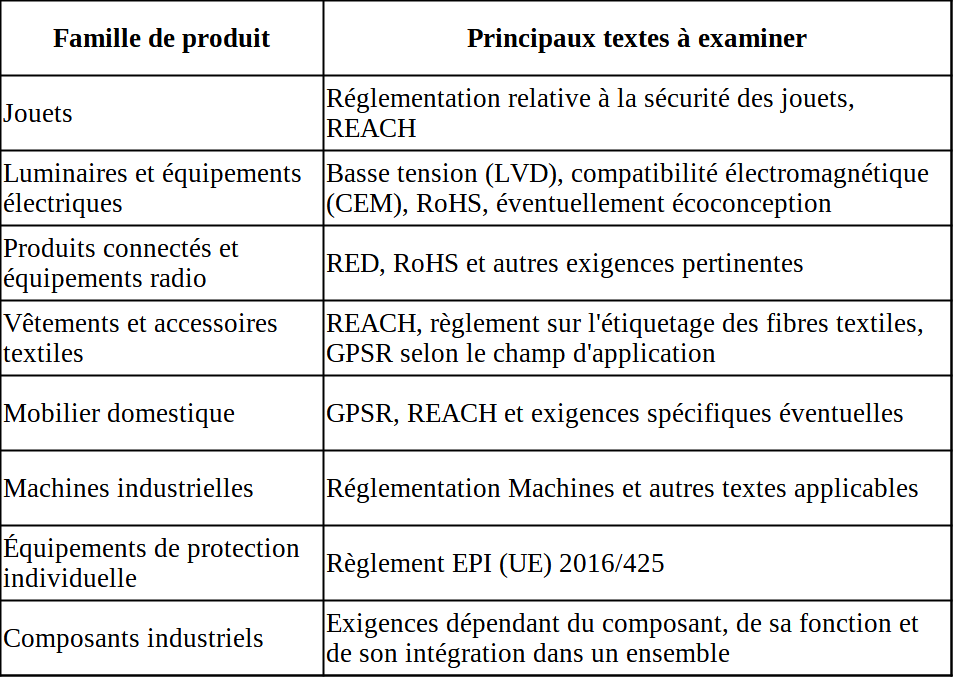
This table is an initial guide, not an exhaustive list.
Compliance must always be analyzed at the level of the reference actually imported.
A piece of furniture fitted with an electrical system, for example, does not have the same obligations as a fully mechanical piece of furniture.
Likewise, a component intended for a machine may be subject to a different framework from that of a finished product sold to consumers.
CE marking: mandatory or not for importing from China?
CE marking is one of the most misunderstood topics in relations between European importers and Asian manufacturers.
Which products must bear the CE marking?
CE marking concerns only the product categories for which European texts provide for it.
This concerns in particular, depending on the applicable regulations:
toys;
electrical and electronic equipment;
radio equipment;
certain machinery;
personal protective equipment;
medical devices;
pressure equipment.
Conversely, you must not affix a CE marking to a product that is not subject to any regulation requiring it.
CE marking is also not an approval issued directly by the European Union, nor by a European body.
It means that the manufacturer declares that its product complies with the applicable European requirements and that it has followed the required conformity assessment procedure.
Generally, the manufacturer carries out or has carried out the necessary assessments, compiles the technical documentation, draws up an EU declaration of conformity and affixes the CE marking under its responsibility.
In other cases, the involvement of a notified body is mandatory.
This is why a document simply titled “CE Certificate” sent by a factory is not enough on its own to guarantee that a product is compliant.
Before considering it as relevant evidence, check in particular:
the exact reference and description of the product;
the European regulations mentioned;
the standards or test methods used;
the associated test reports;
the identity of the issuer;
any involvement of a notified body, where required;
the correspondence between the product tested and the one you wish to import.
This is why documentary verification must be carried out from the supplier qualification stage, and not only at the end of production.
Our article How can you ensure a Chinese factory is reliable before ordering? details the main elements to check before committing to a supplier.
GPSR: product safety for products without CE marking
The absence of CE marking does not mean that a product can be marketed freely without regulatory control.
Regulation (EU) 2023/988 on general product safety, generally called GPSR (General Product Safety Regulation), has applied since 13 December 2024.
It establishes safety requirements for consumer products within its scope, including many products that do not bear the CE marking.
It provides in particular for obligations concerning safety, traceability, identification of economic operators, warnings and information intended for users.
What are the consequences for a French importer?
Depending on the product, you must in particular ensure that:
the product is safe under foreseeable conditions of use;
the information allowing it to be identified is present;
the manufacturer and the economic operators concerned are identifiable;
the necessary warnings and instructions are available;
the information intended for the French market is provided in French;
the necessary documents can be communicated to the competent authorities.
For a distributor importing consumer products from China, these obligations must be anticipated from the development of the packaging and instructions.
REACH: checking the substances contained in products
A product may appear perfectly functional and nevertheless present a non-compliance related to its chemical composition.
This is in particular the purpose of the REACH regulation.
The REACH regulation governs chemical substances in the European Union.
Some of its provisions also concern substances present in imported articles, in particular the restrictions applicable to certain substances and the obligations related to substances of very high concern.
A finished product may therefore be affected by restrictions on certain components or materials.
The materials concerned may include:
plastics and rubbers;
fabrics and coatings;
paints and varnishes;
glues;
metals and surface treatments;
certain accessories and components.
The presence of certain substances of very high concern may also give rise to information or notification obligations.
Take the example of a distributor importing bags containing plastic elements, metal parts and a textile coating.
Compliance is not checked only on the bag as a whole. The regulatory risks associated with the different materials and components must be identified.
It is therefore not enough to ask the supplier:
“Is your product REACH compliant?”
You must first identify which requirements are relevant to the product, then check that the documents and tests provided actually cover the materials used.

RoHS: hazardous substances in electrical and electronic equipment
The RoHS directive limits the use of certain hazardous substances in electrical and electronic equipment within its scope.
It concerns in particular certain substances present in electronic components, solders, plastics and other materials.
But a RoHS report is not enough to demonstrate the overall compliance of electrical equipment.
Depending on its characteristics, it may also be subject to electrical safety, electromagnetic compatibility or radio frequency requirements.
Depending on the product, it may also be necessary to examine other regulations concerning:
electromagnetic compatibility;
low voltage equipment;
radio equipment.
Compliance must be analyzed as a whole, and not regulation by regulation without links between them.
Toys: an example of specific regulation
Toys are among the categories for which European requirements are particularly strict.
Before they are placed on the market, several risks must in particular be assessed:
mechanical risks;
physical risks;
flammability;
chemical risks;
electrical risks;
hygiene.
The importer must also check the technical documentation, the conformity procedures, the CE marking, the warnings, the traceability and the safety information.
As of the publication date of this article, Directive 2009/48/EC remains the applicable framework for toys. The new European regulation adopted in 2025 will fully replace this framework from 1 August 2030.
This also shows that compliance is not set in stone: companies that import regularly must keep track of regulatory developments.

Importer, distributor or manufacturer: who is responsible?
This is an essential question for French companies that buy in China.
The Chinese supplier is responsible for the obligations incumbent on it as manufacturer. But the European company that imports the goods also has its own responsibilities.
The European importer must carry out verifications.
Depending on the applicable regulation, the importer must in particular ensure that the manufacturer has carried out the required assessment procedures, that the mandatory documents are available and that the products bear the necessary markings and information.
It must also react when it identifies a risk of non-compliance or of safety.
The argument “our supplier assured us that everything was compliant” is not enough to demonstrate that these obligations have been met.
Beware of products marketed under your own brand.
A French company that has a product manufactured in China and markets it under its own name or brand may be considered as the manufacturer within the meaning of the applicable regulation.
This is in particular a situation to examine when developing private-label (own-brand) products.
The consequences can be significant: the company may have to assume the manufacturer's regulatory obligations, beyond those of a standard importer.
For own-brand projects, compliance issues must therefore be integrated from the product design stage, and not only at the time of import.
Which documents should you request from a Chinese supplier?
There is no universal documentary file.
The documents to obtain depend on the product and the applicable texts. Nevertheless, several categories of documents come up frequently.
1. Test reports
Request the reports relevant to the requirements identified.
For each report, check:
the exact reference tested;
the date of the report;
the materials concerned;
the standards or methods used;
the results;
the identity of the laboratory;
the correspondence between the sample tested and the product ordered.
A report concerning a “similar” product is not necessarily sufficient.
A change of material, paint, component or design may also render certain previous tests unusable.
2. The EU declaration of conformity
When required by regulation, the EU declaration of conformity is an essential document.
It identifies in particular the product and the regulations with which the manufacturer declares compliance.
For products concerned by CE marking, the manufacturer must in particular carry out the conformity assessment, compile the technical documentation and issue this declaration.
3. The technical file
Depending on the product, it may include:
product description;
drawings;
technical characteristics;
materials and components;
risk analysis;
standards applied;
test results;
labeling;
instructions;
warnings.
The whole must correspond to the product actually manufactured, not simply to a reference close to the supplier's catalogue.
4. Labeling and traceability information
You must also check the elements that appear on the product, the packaging and the documentation.
Depending on the product, this may include:
product identification;
batch or serial number;
manufacturer;
importer;
warnings;
instructions;
regulatory markings.
Packaging validated too late may require a complete reprint, even if the product itself is technically compliant.
“We already export to Europe” is not proof
This is a common phrase in exchanges with a Chinese supplier.
It may be reassuring, but it does not constitute sufficient proof.
A factory may produce dozens of references with different materials, components and levels of compliance.
Likewise, the test reports it holds may concern an older version of the product or a different composition.
You must therefore verify the supplier and the documents specific to the exact references you wish to import.
In projects with greater industrial stakes, a Factory Verification Audit can also help verify the existence of the factory, its capacities, its equipment, its organization and the elements it communicates before production is launched.
The European importer has its own responsibilities
This is one of the most important points to understand.
The fact that the manufacturer is located in China does not mean that the European importer is relieved of all responsibility.
For products subject to CE marking, the importer must in particular ensure that the manufacturer has carried out the necessary steps and that the required documentation is available.
For products concerned by the GPSR, the importer also has its own verification obligations and must not place on the market a product that it knows or suspects to be dangerous or non-compliant.
In other words:
“The supplier told me the product was compliant” is not sufficient proof.
The importer must be able to demonstrate that it has carried out the verifications corresponding to its role.
When should compliance be checked in a sourcing project?
The safest method is to integrate the regulatory requirements before the final choice of supplier.
A relevant work sequence is as follows:
Product definition → regulatory analysis → specifications → supplier qualification → sample → tests → validation → production → quality control → shipment.
Why?
Because a regulatory requirement can influence:
the material;
a component;
the paint;
the dimensions;
a closure system;
a battery;
a warning;
the packaging.
Discovering a compliance problem after production can cancel out a large part of the savings obtained on the purchase price.
This is also why a good sourcing partner should not simply find a factory. As we explain in our article on choosing a good sourcing agent in China, the support must also cover supplier qualification, development, production monitoring and the verifications necessary for the project.

What are the risks in the event of non-compliance?
Depending on the product and the seriousness of the problem, non-compliance can lead to:
goods being blocked or held;
prohibition of marketing;
withdrawal from the market;
product recalls;
corrective labeling;
new tests;
destruction or bringing back into compliance;
penalties;
financial losses.
The cost is therefore not limited to the laboratory or the goods.
Non-compliance can also delay a launch, tie up stock and affect the brand's image.
The five common mistakes when importing from China
Mistake no. 1: believing that a factory already exporting to Europe is necessarily compliant
A manufacturer may supply compliant products to certain customers and other references that do not meet the same requirements.
The documents must always be verified for the product you are ordering.
Mistake no. 2: requesting a “CE certificate” without identifying the regulation
Compliance is not a standardized documentary formality.
You must first determine the applicable texts, then the assessment procedures and the necessary evidence.
Mistake no. 3: using the reports of a similar product
A report corresponding to another model, another material or an older version may be insufficient.
The commercial references and technical characteristics must be consistent.
Mistake no. 4: waiting until the end of production to carry out the tests
If the tests reveal non-compliance after several thousand parts have been manufactured, the consequences can be costly.
Depending on the nature of the problem, it may be necessary to modify the products, run new tests or give up marketing the stock.
Mistake no. 5: confusing quality inspection and regulatory compliance
A quality control can confirm that the dimensions, finishes, quantities or packaging correspond to the specifications.
It does not replace the necessary regulatory tests.
Conversely, a satisfactory laboratory report does not guarantee that all the units produced correspond to the sample tested.
The two approaches are complementary.
How Diex International helps secure your imports
Successful international sourcing is not only about obtaining the best factory price.
You must also select a partner capable of manufacturing the expected product, complying with the specifications and maintaining the validated characteristics throughout production.
At Diex International, we integrate compliance and quality issues into the organization of sourcing projects in Asia.
Depending on the project's needs, our support may include:
taking the relevant regulatory requirements into account in the specifications;
sourcing and qualifying suitable suppliers;
reviewing the documents provided by the factories;
coordinating tests with competent laboratories;
developing and validating samples;
monitoring changes and corrective actions;
quality inspections during or at the end of production;
checking markings, instructions and packaging before shipment.
The goal is to limit industrial and commercial risks before the goods leave the factory.
Specialized legal or regulatory analysis and attestations of conformity falling under competent bodies can, where necessary, be carried out with authorized professionals.
This logic is directly integrated into our approach to strategic sourcing in Asia: identifying, qualifying and securing industrial partners before and during production.
Conclusion: compliance must be anticipated before the order
Before importing a product from China, the right question is not:
“Does the factory have the European certifications?”
You must first ask yourself:
“Which regulations apply exactly to my product?”
It is this analysis that then makes it possible to determine the relevant standards, the necessary tests, the documents to obtain and the information to display on the product or its packaging.
Compliance must be anticipated before production, and extended through documentary verifications and appropriate quality controls.
It helps reduce the risks of blocking, delay, non-compliance and financial losses.
Do you have an import project from China or another Asian country?
Diex International supports you in finding manufacturers, product development, supplier qualification and production monitoring.
Request a sourcing pre-study to assess the conditions for carrying out your project and identify the main points of vigilance before committing your production.
Frequently asked questions
Is CE marking mandatory on all products imported from China?
No. CE marking concerns only the product categories subject to a European regulation requiring it. Some products can be marketed without CE marking while still having to comply with other safety or composition obligations.
Is a Chinese test report recognized in Europe?
Not necessarily. A report issued by a laboratory located in China can be relevant, provided that the test methods, the laboratory's competence, the reference tested and the results meet the applicable requirements. Where the regulation requires a specific involvement of a notified body, a simple laboratory report is not enough.
Who is responsible for the compliance of a product imported from China?
Responsibilities depend on the product, the role of each company and the applicable texts. The European importer has its own obligations. A company marketing a product under its brand may also be considered as the manufacturer within the meaning of certain regulations.